
Can Long-Term Stress Rewire Your Metabolism? Here’s What Research Shows
March 16, 2026

You’ve been doing everything “right.” Watching what you eat, trying to stay active, and getting to bed at a reasonable hour. But the scale won’t budge, your energy is low, and the cravings feel relentless. Sound familiar?
If you’ve been stressed for a long time, it may be affecting your body more than you think. The relationship between long-term stress and metabolism is one of the most underappreciated factors in weight and overall health and the research is eye-opening.
At NiuOla Health in Olympia, Washington, we take a whole-person approach to care. That means we don’t just look at what you’re eating or how much you’re moving. We look at everything that’s happening in your life, including chronic stress, because it genuinely changes how your body functions at a biological level.
What Happens to Your Body Under Chronic Stress
Short-Term Stress
Stress isn’t always detrimental. Short-term stress is the kind that helps you meet a deadline or react quickly in an emergency. It is a normal and even helpful part of life. The problem begins when stress becomes chronic and long-lasting.
The Stress Response
When your brain perceives a threat (whether that’s a bear chasing you or a never-ending email inbox), it triggers your body’s stress response. Your adrenal glands release hormones, primarily cortisol and adrenaline, to prepare you to fight or flee. Your heart rate rises. Your muscles tense. Your digestion slows. Your blood sugar spikes.
In the short term, this is a survival mechanism. But when stress becomes a constant state, that same hormonal cascade runs on repeat and your body starts to pay the price.
According to the National Institutes of Health (NIH), prolonged exposure to stress hormones is associated with a wide range of physical health consequences, including disrupted metabolism, inflammation, and increased risk of chronic disease.
How Long-Term Stress and Metabolism Are Directly Connected
Here’s where it gets important: cortisol doesn’t just make you feel stressed it actively changes how your metabolism works.
Cortisol and Blood Sugar
Cortisol signals your liver to release glucose into your bloodstream to give you quick energy. In a true emergency, that’s useful. But if cortisol is chronically elevated, your blood sugar stays elevated too. Over time, this can lead to insulin resistance, a condition where your cells stop responding properly to insulin. Insulin resistance is a core driver of weight gain, metabolic syndrome, and type 2 diabetes.
Cortisol and Fat Storage
Research shows that chronically high cortisol promotes the storage of fat especially visceral fat, the fat that accumulates deep in the abdomen around your organs. Harvard Health Publishing notes that visceral fat is particularly problematic because it’s metabolically active and associated with increased inflammation, heart disease, and insulin resistance.
Cortisol and Muscle Mass
Cortisol is also catabolic, meaning it can break down muscle tissue for energy. Since muscle is more metabolically active than fat, losing muscle mass over time slows your resting metabolism, making it even harder to maintain a healthy weight.
Stress, Appetite, and Cravings: The Biology Behind “Stress Eating”
If you’ve ever reached for chips, cookies, or comfort food during a stressful week, you’re not weak-willed. You’re human—and your hormones are working against you.
Chronic stress disrupts two key appetite-regulating hormones:
Ghrelin — The Hunger Hormone
Ghrelin increases under stress, making you feel hungrier than you actually are.
Leptin — The Fullness Hormone
Leptin becomes less effective, so you don’t feel satisfied even after eating.
On top of that, cortisol specifically drives cravings for high-fat, high-sugar foods. These foods temporarily blunt the stress response, which is why the urge feels so compelling. The Mayo Clinic describes this cycle as a common but significant contributor to weight gain in chronically stressed individuals.
Stress, Sleep, and Metabolic Health
Long-term stress and metabolism are also connected through sleep or the lack of it.
Elevated cortisol at night makes it harder to fall asleep and stay asleep. And poor sleep independently disrupts metabolism by increasing ghrelin, decreasing leptin, impairing blood sugar regulation, and reducing the body’s ability to recover and repair. The CDC identifies poor sleep as a significant risk factor for obesity and metabolic disease.
The Vicious Cycle
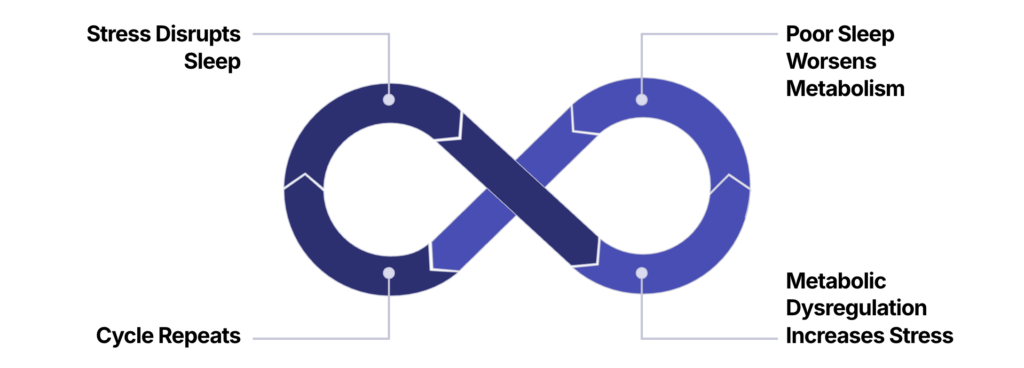
It becomes a cycle: stress disrupts sleep, disrupted sleep worsens metabolic function, and metabolic dysregulation makes everything harder including managing stress.
Breaking this cycle requires addressing all three elements together not just one in isolation.
What You Can Do to Support Your Metabolism and Reduce Stress
The good news? This cycle can be interrupted. While there’s no single fix, there are evidence-based strategies that genuinely help.
To Reduce Cortisol and Support Your Stress Response
- Practice mindfulness, meditation, or deep breathing daily, even 10 minutes matters
- Prioritize consistent, quality sleep (7–9 hours for most adults)
- Spend time in nature, which research shows lowers cortisol levels
- Move your body regularly, but choose gentle forms of exercise like walking or yoga during high-stress periods, as intense exercise can temporarily spike cortisol
To Protect Your Metabolism
- Eat regular, balanced meals to help stabilize blood sugar throughout the day
- Focus on protein, fiber, and healthy fats to support satiety and reduce cravings
- Limit caffeine and alcohol, both of which can worsen the cortisol response
- Work with a knowledgeable provider who can assess your full hormonal and metabolic picture
Personalized Support Makes a Real Difference
Understanding that long-term stress and metabolism are biologically linked changes everything about how we approach weight and health.
At NiuOla Health, a direct primary care clinic in Olympia, Washington, Dr. Tui Lauilefue brings a uniquely compassionate and comprehensive lens to this work. Our direct primary care model means you have more time with your doctor, more access to care, and a relationship built on trust rather than rushed appointments. Whether you’re navigating metabolic challenges, exploring personalized medical weight loss support, or simply trying to understand why your body isn’t responding the way you expect we’re here to help you make sense of it all, without judgment.
Ready to Take the Next Step?
If chronic stress has been part of your health story, you deserve support that actually accounts for that.
We invite you to schedule your appointment with Dr. Tui Lauilefue at NiuOla Health in Olympia, Washington. Together, we’ll look at the full picture of your metabolic health and create a personalized plan that works for your real life.
Your body isn’t broken. It’s responding to everything you’ve been carrying. Let’s figure it out together.
👉 Contact NiuOla Health today to learn more or schedule your appointment.
